Materialism, Philosophy Zombies, and Logic: Don't Try Teleportation!
- Jul 11
- 4 min read

Traveling from New York to London by clicking a button sounds pretty great, right? No crowded airplanes needed, you’re just there in under a second. This is teleportation, the conception of instantaneous travel. Disappear in one place … and reappear in another.
Often, people consider the possibility of a reconstruction-deconstruction teleporter machine: a system of two devices (one on the origin side and one on the destination side). The origin teleporter would scan a person’s entire body, down to each atom. Subsequently, it would transfer the scan data to the destination teleporter, which would reconstruct the person’s body atom for atom. To finish the process, the body would be deconstructed, completely obliterated at the atomic level, on the origin side.
So, you can imagine that if someone named Tom climbed in the New York teleporter and traveled to London, he would sure enough appear to have gone from one place to the other in an instant. But can we be sure it really is the same Tom? Many fear that the original Tom was destroyed, and a clone, a Tom 2.0 so to speak, was created in his place.

The question of Tom’s identity leads to the question of if there is something beyond the physical that differentiates us from one another. A soul, perhaps? David Chalmers, a NYU philosopher, imagined “philosophy zombies,” beings that, from the outside, appear exactly identical to humans. But there’s an important distinction: on the inside, they’re devoid of a soul. Upon stubbing its toe, a zombie would recoil and cry out in pain exactly like a human, yet feel nothing inside. No pain. No feelings. Just as a rock falls under gravity or a chemical reaction drives toward equilibrium, the zombie’s behavior would be an automatic reflex to the physical laws of nature, with no inner conscious experience accompanying it. The zombie would be a hunk of meat, just pure biological machinery. The fact that we can even conceive of this soulless being, Chalmers says, suggests that consciousness is not a product of material interactions.

As a materialist, one would have to accept the stark dichotomy of matter and void, disregarding a third metaphysical state of a soul. According to this worldview, all decisions made by life, including life with the highest rational intellect, would be driven entirely by chemical processes and physical laws. This idea was proposed by Democritus, and it makes sense from a scientific perspective. Furthermore, it explains the automatic nature of philosophy zombies.

The following is an example of a syllogism, a logical structure invented by Aristotle that functions by drawing a conclusion from two premises, one major and one minor. This specific one demonstrates Democritus’s theory of determinism.
Major Premise: Humans are composed entirely of atoms. There is no evidence of a non-atomic component.
Minor Premise: Atoms are governed by physical laws
Conclusion: Therefore, humans too are governed by physical laws

Note that this is what is called an enthymematic syllogism. As it stands above, it is not perfectly logically sound. As it currently stands it lacks an implicit bridging premise. That’s not to say it’s wrong. It’s just casually phrased. Aristotle believed enthymemes were actually an acceptable form for practical argumentation, since stating every single premise required would quickly become tedious work. So, what’s missing? To complete the logical flow, we add the idea that a composition of atoms will exhibit the same behavior under the influence of physical laws as individual atoms:
When atoms that obey physical laws combine to form a larger aggregate, the adherence to physical laws transfers from the individual atoms to the aggregate as a whole.
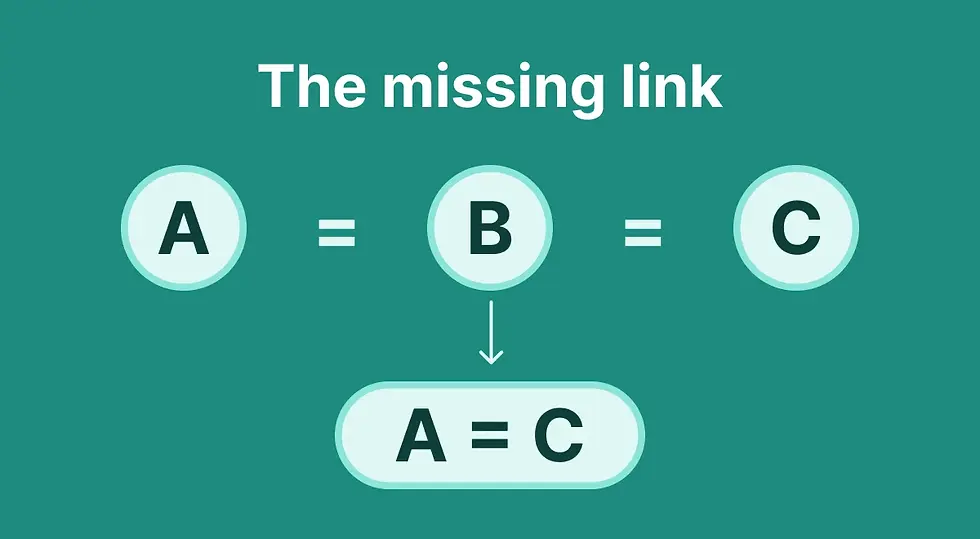
At its core, this argument is a formulation of the mathematical transitive property: If A is composed of B, and B has property P, then A has property P.
The conclusion of this argument suggests a form of determinism. It argues that soulless humans are controlled by environmental forces, not their own free will, thus explaining the nature of philosophy zombies.
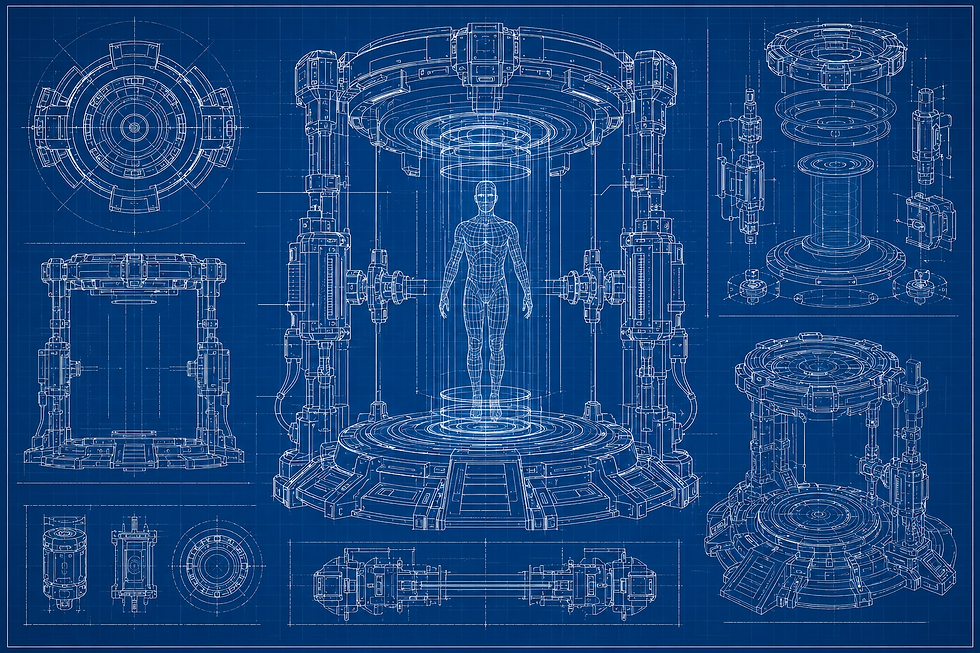
Going back to the topic of teleportation, this means that even if we were able to clone a person’s body atom for atom so that it were utterly indistinguishable at the atomic level, the newly created being would still not be the same being as the original person. Their inner identity would slowly diverge as they form new memories and have different experiences. More interestingly, the clone could be a zombie, created by science but lacking a soul or inner identity.
Despite the fact that the two clones are physically identical, everyone would deny that the consciousness of the original would suddenly hop bodies and begin to inhabit both. This thought experiment is a rejection of materialism, and it adds complication to theories surrounding free will and determinism.
To recap the argument, don't try teleportation! It would destroy you, while a philosophy-zombie-clone of you would come out the other end and tell all of your friends that it was the best thing ever. Seriously, take a plane instead and keep your non-physical identity.


Comments